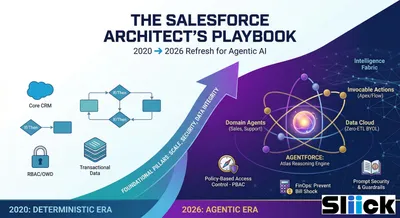


Salesforce is almost always purchased with grand expectations - bold marketing and transformational intentions to elevate organisations into the digital revolution. Almost all organisations, however, follow a remarkably similar and arduous journey towards Salesforce maturity. Success is not just about the technology; it is about building a scalable Platform Capability that turns a “System of Record” into a high-velocity engine for business value.
Achieving transformational success requires moving beyond tactical execution and towards a structured Competency Centre (CoE). This post distils the framework required to build a market-leading Salesforce capability that scales with your organisation’s ambitions.
Salesforce Platform Maturity
To lead in the modern enterprise landscape, organisations must move from reactive maintenance to strategic adaptation.
graph LR
    classDef level fill:#f9f9f9,stroke:#333,stroke-width:2px;
    L1[1. Initial<br/>Ad-hoc]:::level --> L2[2. Emerging<br/>Reactive]:::level
    L2 --> L3[3. Practising<br/>Governed]:::level
    L3 --> L4[4. Optimising<br/>Value-Driven]:::level
    L4 --> L5[5. Leading<br/>Strategic]:::level
-
Initial / Minimal (Ad-hoc & Siloed) - Most organisations start here. Salesforce has been purchased, but there is no internal expertise or defined operating model. Success is largely ad-hoc, dependent on the brilliance of individuals or pure luck. Risks at this stage include high platform attrition and a failure to launch core features.
-
Emerging (Reactive & Repeatable) - Capability is developing, and basic processes are forming. Knowledge exists for repeatable steps and support for known features. However, a common pitfall is a “lift and shift” approach - copying legacy processes into Salesforce without leveraging the platform’s native architecture.
-
Practising (Governed & Proactive) - The capability is mature, governance structures are in place, and the operating model is well-defined. Teams deliver consistent value, roles are understood, and solutions are thoughtfully architected. The organisation knows how to deploy, but may still face bottlenecks in release agility or bureaucratic friction.
-
Optimising (Value-Driven & Automated) - There is a continuous focus on streamlining delivery. Salesforce DX is adopted, CI/CD is automated, and quality assurance is high. Metric-driven dashboards are used to proactively monitor platform health and user adoption. Feature teams are self-contained and autonomous.
-
Leading (Strategic & Adaptive) - The capability sets the industry standard. Salesforce is no longer just a “tool” but a strategic asset that enables business agility. The organisation acts as a model for others, using continuous feedback to adapt their way of working and stay ahead of the competitive curve.
Core Competencies for Platform Excellence
When you have a well-oiled Salesforce capability machine:
- Speed to Value. Solutions are delivered in days, not months. From ideation to production, the process is streamlined to drive meaningful iterations and increase user adoption.
- Human-Centric Design. Solutions are not designed in isolation, but co-created with business partners to solve real pain points and drive measurable outcomes.
- Automated Reliability. Everything that can be automated - testing, deployment, data loads - is automated. This builds consistency and quality into the DNA of the platform.
- Strategic Partnership. IT and Business operate as one team, working towards a common vision with full accountability and empowered decision-making.
Each of these competency topics is a pillar of a modern CoE:
1. Vision & Strategic Alignment
Too many “transformation” programs fail because they implement technology without a clear “WHY”. A leading capability defines the business drivers first. What are the paint points we are removing? What is the north star for the platform? Without this alignment, teams feel disconnected from leadership, and the platform fails to deliver on its expected ROI. See our Salesforce Architecture Framework for a breakdown of modern architectural alignment.
2. High Performing Team & Culture
Methods and processes can change, but motivated people working as a team are what make “amazing” happen. Successful teams have high engagement, constant collaboration, and a collective thirst for learning. You don’t necessarily need the “brightest” minds in isolation; you need a collaborative unit that values peer support and continuous improvement.
3. Solution Design & Architectural Integrity
A common pitfall is over-customisation or building solutions that simply will not scale. Solution design must be intuitive and aligned with the Salesforce roadmap. One of the greatest risks is rolling out a “Ferrari” when a “Toyota” was fit for purpose - leading to wasted investment and poor adoption.
4. Data Excellence & Single Source of Truth
Data is more critical than ever. A leading CoE must master data quality, harmonisation, and integrity. This ensures that the platform acts as a reliable foundation for all business decisions and integrations. Without high-fidelity data, even the best-architected solution will fail to provide meaningful insights.
5. Engineering Quality & “Clicks before Code”
Salesforce is a feature-rich, packaged platform. Custom solutions should be the exception, not the rule. Delivery teams must have a deep understanding of native features and maintain a “Configuration First” mindset. When code is required, it must follow strict hygiene - peer reviews, static analysis, and modular design.
6. Continuous Delivery & Modern DevOps
Achieving excellence in delivery means minimising the time between “Commit” and “Production”. Teams must skill up in modern tooling (like Salesforce DX and DevOps Center) to automate routine tasks like environment setup, branch merging, and deployments. This frees up developers to focus on building features rather than managing infrastructure.
7. Quality Assurance & Automated Testing
Manual testing for everything creates a massive bottleneck. A leading capability employs toolsets for automating as much as possible - from functional regression to security scans. By building quality into the development process, you ensure that releases are consistent and reliable.
8. Operational Excellence & Governance
Business as Usual (BAU) support is often an afterthought. A mature CoE institutionalises a clear Demand Management process - filtering business requests through a roadmap that reflects organisational priorities. This includes regular Health Checks (using Salesforce Optimizer and Security Review tools), proactive monitoring, and a defined communication strategy for rolling out new features to users.
Key Takeaway
Maturing from a simple CRM setup to a leading platform capability is an organisation-wide journey of learning and adaptation. The speed of digital business requires a shift in mindset from “managing a system” to “orchestrating a capability”.
Becoming a “Leading” organisation doesn’t happen by accident; it requires seasoning, trusted advice, and a commitment to continuous improvement. Discuss your Salesforce transformation needs with professional services like Sliick to help fast-track your experience, leverage learnings from other successful setups, and maximise your investment in the Salesforce ecosystem.