
A Salesforce Implementation Partner - at the most basic level - is an organisation you engage to help configure, customise, and optimise your Salesforce instance. Often referred to as System Integrators (SIs) or Consultants, these partners offer a spectrum of services ranging from strategic advisory and experience design to technical development, program management, and operational support.
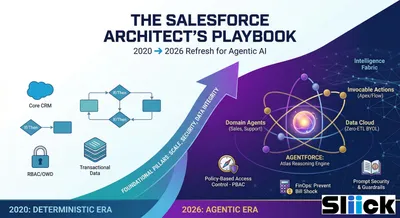
In the evolving “Agentic Era” of Salesforce, the role of the partner has shifted from simple implementation to architecting verifiable business outcomes.
The Partner Ecosystem
Historically, Salesforce used a complex four-tier system (Silver, Gold, Platinum, and Summit). However, as of March 2026, the program has been radically simplified to focus on technical mastery and delivery over administrative checklists. The ecosystem is now organised into two primary tiers: Summit and Select.
graph TD
    subgraph Tiers ["The Simplified Partner Program"]
        direction TB
        Summit["Summit<br/>Top-Tier Strategy | Enterprise Scale | High-Stakes Agentic Architectures"]
        Select["Select<br/>Delivery Experts | Specialised Competencies | Outcome Focused"]

        Summit --- Select
    end

    style Summit fill:#f9f,stroke:#333,stroke-width:2px
    style Select fill:#dfd,stroke:#333,stroke-width:1px
Outcome-Based Performance Success is no longer measured solely by the number of consultants on staff or manual checklists. Instead, Salesforce now prioritises verifiable customer outcomes, CSAT scores, and active platform consumption. This ensures that the partner’s success is mathematically linked to the actual value you realise from the platform.
Core Competencies over General Knowledge Salesforce has distilled over 170 legacy distinctions into 28 core competencies aligned with modern buying patterns. These include high-demand areas like Agentforce (AI Agents), Data 360, and industry-specific specialisations. When evaluating a partner, you should look for specific competencies that match your technical requirements rather than just their company size.
Why Engage an Implementation Partner?
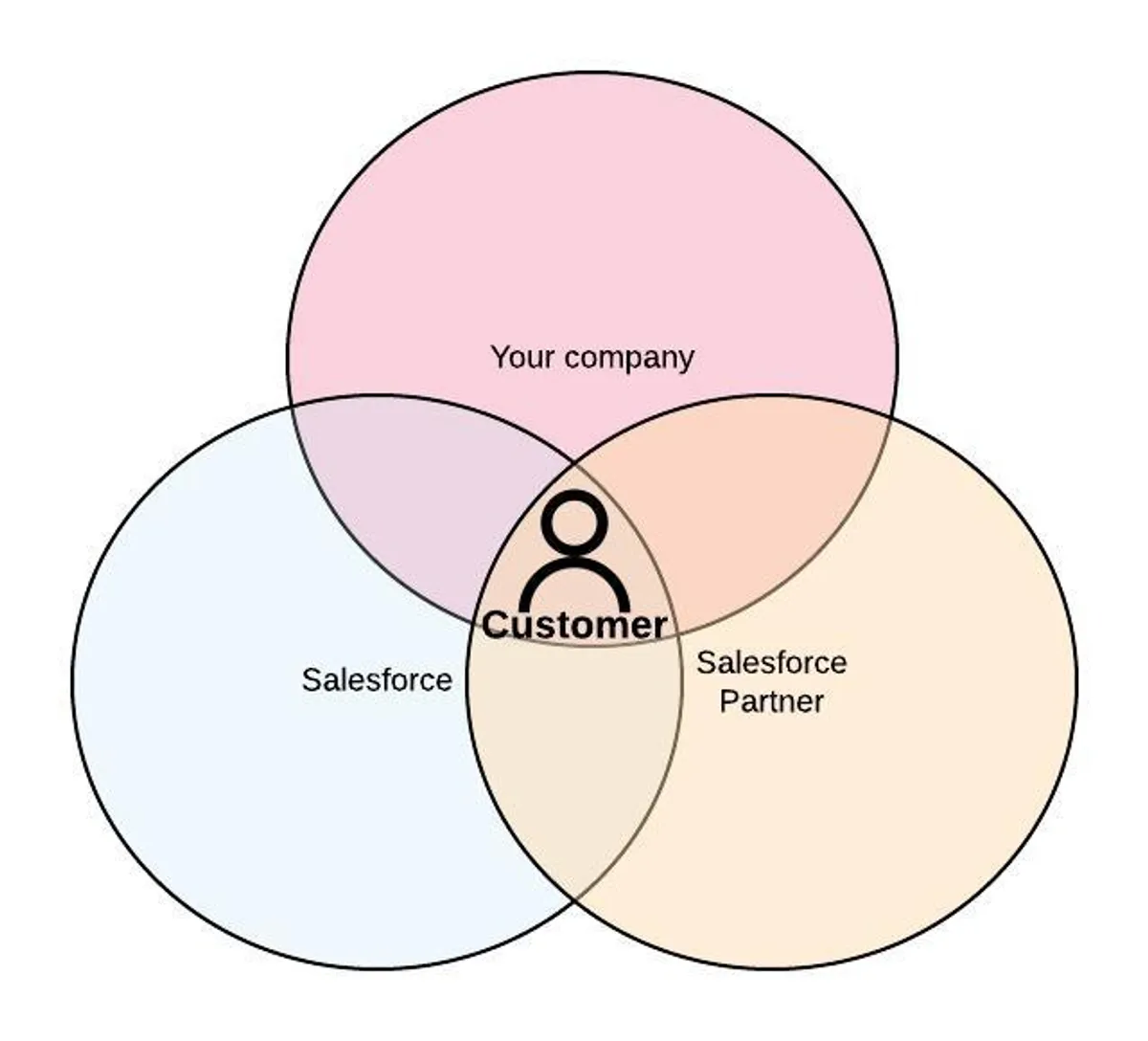
The relationship between the Customer, Salesforce, and the Partner forms a “Success Trinity.” A trusted partner brings the platform expertise and cross-industry experience required to lead and coach your internal teams toward successful outcomes.
graph TD
    C[Customer] <--> P[Implementation Partner]
    P <--> S[Salesforce Platform]
    S <--> C

    subgraph "The Success Trinity"
        direction LR
        C
        P
        S
    end
Industry Expertise Partners possess deep knowledge of industry best practices. They can recommend optimal ways to refine business processes based on proven patterns, having solved similar challenges for other organisations in your sector.
Specialised Skillsets (The Agentic Stack) Modern implementations require more than passive tools; they require active AI agents. Partners are now the essential architects bridging the systems of context, work, and agency. Look for partners who invest heavily in hands-on verification and sandbox validation rather than just theoretical certifications.
Frameworks and Accelerators Experienced partners do not start from scratch. They bring established methodologies, document templates, coding standards, and proprietary tools for project management, automated testing, and continuous deployment. These “accelerators” significantly reduce risk and time-to-market.
Engagement Models
The level of reliance on an Implementation Partner depends on your internal team’s maturity, availability, and long-term Salesforce strategy.
graph LR
    A["Do It For Me<br/>(Vendor Led)"] --- B["Do It With Me<br/>(Collaborative)"] --- C["Do It Myself<br/>(Customer Led)"]

    subgraph "The Collaboration Spectrum"
        direction LR
        A
        B
        C
    end
1. Do it for me (Vendor Led)
Ideal for organisations with no existing Salesforce expertise or capacity. The partner handles the end-to-end delivery.
- Pros: Rapid access to expert skills; minimal pressure on internal business teams.
- Cons: Higher implementation costs; limited internal knowledge transfer, leading to long-term vendor dependency.
2. Do it with me (Collaborative)
The recommended model for most organisations. Work is delivered through a blended team, often using a “two-in-a-box” approach where internal staff are paired with external consultants.
- Pros: Balanced cost; active knowledge transfer; builds internal capability for post-go-live support.
- Cons: Increased management complexity; requires significant commitment from internal Subject Matter Experts (SMEs).
3. Do it myself (Customer Led)
Suitable for mature organisations with established Salesforce Centres of Excellence (CoE). Partners are engaged only for specific niche expertise or to augment the team during peak demand.
- Pros: Lowest vendor costs; complete platform ownership and self-sufficiency.
- Cons: Difficulty scaling for massive projects; risk of internal “tunnel vision” without external industry perspective.
The Three Pillars of Partner Failure
Understanding why projects fail is as important as knowing what leads to success. Look for these three critical risk factors during your evaluation:
1. Failure of Skill and Continuity A partner is only as good as the individuals assigned to your project. A common risk is “bait and switch,” where senior experts lead the pre-sales process but are replaced by junior resources once the contract is signed. High employee attrition within the partner’s practice can also lead to fractured architectures and lost context.
Recommendation: Ensure that the architects presenting during selection are the ones who will lead the delivery. Inquire about their attrition rates and retention strategies.
2. Failure of Management and Coordination Individual brilliance cannot compensate for poor leadership. Large-scale programs amplify coordination issues. Mismanaged teams lack direction, leading to either stagnation or extreme burnout as they attempt to compensate for inadequate planning.
Recommendation: Ask for case studies not just of success, but of projects that went off-track - and specifically how the partner’s leadership intervened to remediate the situation.
3. Failure of Expectations Most project disappointments stem from a gap between the high-level vision and the granular reality of implementation. Without a tight feedback loop, requirements can morph into unmanageable complexity, leading to delays and budget overruns.
Recommendation: Insist on an agile delivery approach. This goes beyond daily stand-ups; it requires active business engagement. Frequent demos and “touch-and-feel” sessions ensure the product aligns with expectations as it is being built, preventing the “requirement throw” over the fence.
At Sliick, we built our practice specifically to avoid these systemic failures and to bridge the gap between traditional implementation and the high-velocity demands of the Agentic Era.
Where Sliick Fits
We aren’t for every customer. If you are looking for a massive, Tier 1 “do-it-all” vendor with thousands of resources across every possible technology stack - that is not Sliick.
We are a boutique consultancy built specifically for the Agentic Era. While we are a new SI, we are led by an ex-Salesforce founder and Certified Technical Architect (CTA) with 20+ years of experience across a vast breadth of industries and roles.
Our Salesforce background gives us deep connections and relationships within the ecosystem - from account teams to product engineering. This enables us to align your digital vision directly with Salesforce’s internal roadmaps, ensuring that your implementation is always in sync with the platform’s trajectory.
Instead, we focus on three core principles:
- Architect-Led Delivery: The senior architects you meet during the selection process are the same people who will be hands-on in your sandbox. We eliminate the risk of “bait and switch” by ensuring our top talent is directly involved in your delivery.
- Outcome-First Agility: We don’t just run sprints for the sake of ceremony. We deliver verifiable business value. Our success is directly linked to your platform’s active consumption and the realised ROI of your Agentic transformation.
- Hyper-Efficiency Through AI: We don’t just implement AI; we use it to build. By leveraging advanced agentic frameworks and AI-augmented delivery tools, we achieve extreme efficiency. We are capable of compressing traditional implementation timelines - turning what used to be months of build into days - without compromising on architectural integrity. For a concrete example of this in action, see how a secure non-profit MVP was built in just 48 hours.
If you value precision, technical mastery, and a partner who treats your success as mathematically inseparable from their own, then we are the right fit for you.
Book a consultation to discuss your Salesforce journey
Summary
Choosing a partner is not just about technical capability; it is about finding a strategic ally who understands your business objectives. By evaluating partners through the lens of their verified competencies, their willingness to collaborate, and their commitment to talent continuity, you can significantly de-risk your Salesforce journey and maximise your return on investment.